
The road goes on forever.
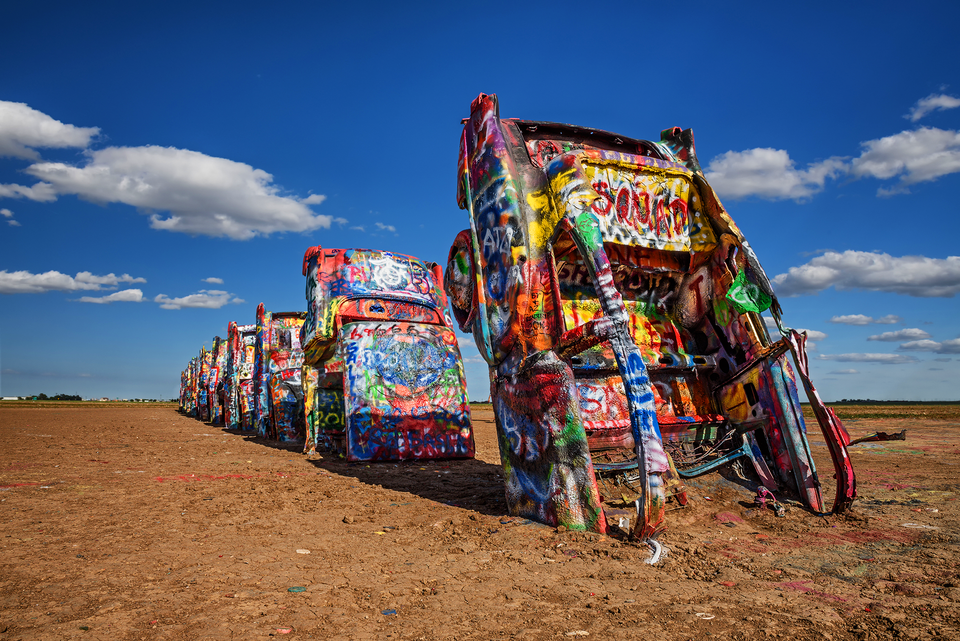
In 1926, America decided it needed a road.
Not quite a road, as it turned out. More of a road-shaped concept.
The federal government designated U.S. Highway 66 as a 2,400-mile route from Chicago to Los Angeles. The Feds didn't even build it. They designated it. It was already built, assembled out of local roads, state roads, farm roads, dirt roads, and whatever else the folks back in Washington D.C. could plausibly strap on to connect Illinois and California together in holy roadtrip matrimony.
The road was named before it was finished, an early triumph of American optimism: announce the thing, then build it. Congress does this with budgets. I do it sitting in front of my keyboard. I'm soaking in it.
It still took the government twelve years.
And it was already built.
In Oklahoma, one stretch of America's brand-new coast-to-coast marvel was nine feet wide. Nine feet. More hallway than highway.
And it wasn't even the Route's fault. The "Sidewalk Highway," as locals fondly called it, had been poured in 1921-22, a full four years before the Feds stepped in and slapped a number on it. The story goes that Oklahoma had exactly enough money to either pave the whole stretch as one lane, or pave half the stretch as wider two lanes.
Faced with that choice, Oklahoma did what it does when it sees a tornado: it chose the hallway.
Route 66 crossed eight states, linking farms, towns, deserts, truck stops, diners, motels, and people who badly wanted to be somewhere else. During the Dust Bowl, it became the route west for families fleeing Oklahoma and Arkansas in such numbers that John Steinbeck, in 1939, gave it the nickname that stuck for good: Route 66, the Mother Road. The government used the opportunity to put thousands of unemployed men to work paving and widening it where it wasn't.
People, who had nowhere to escape to, built the first unified improvements to the route that pointed toward Steinbeck's Dust Bowl Promised Land.
Being in the land of unbridled capitalism, it was also one hell of a business opportunity. A road brings cars. Cars need gasoline. People in cars need food. People who've been driving all day need places to sleep. So Route 66 grew its own ecosystem of filling stations, cafés, and motor courts. Even a two-story wigwam you could sleep in of if you were so inclined. And, within a decade or two, the whole miserable migration of Dust Bowl refugees quietly curdled into something the tourism industry now chose to remember as being carefree.
Bobby Troup wrote a hit song about getting your kicks on it in 1946. Nobody wrote a hit song about the drought, though people buy the recordings today.
"You can't have a light without a dark to stick it in." — Arlo Guthrie
That was the first great transformation. The second was more spectacular, and considerably less sentimental, which is as on-brand for America these days as it was then, too, and it was triggered because America always favors the bigger and the faster.
After World War II, Americans bought cars like the country had personally invented the concept. We hadn't, but we mass-produced them without peer. Route 66 got crowded. Its bridges groaned. Its lanes were too narrow. Its curves were too tight for springy land yachts. Not jet-set enough.
Its little towns, the very ones the road had made prosperous, had the audacity to slow traffic down with traffic lights and ticket you for running them. The road that once represented modernity was becoming an obstacle to it.
Pretty much how humans have always approached things.
So America did what America always does when confronted with an insufficiently modern version of a thing it has already modernized once: it modernized it again. In 1956, Eisenhower backed the Interstate Highway System, and five interstates rose up that swallowed Route 66 whole: wider, straighter, faster, and mercifully free of the inconvenience of driving through quaint towns where someone might actually wave at you.
Friendly-like. Wave at you friendly. Not the New York style.
This was progress. And progress, annoyingly, worked.
By 1985, Route 66 was officially decommissioned, struck from the federal map like the phone numbers you forgot with the advent of cellphones.
Steinbeck's Mother Road was dead.
Except it wasn't. Because almost the instant America finished eliminating Route 66 as a useful way of getting somewhere, Americans began organizing, with real fervor, to save it as a place worth going.
Associations formed. Faded alignments got remarked with little historic-route shields. Shuttered motor courts reopened as museums you could spend the night experiencing.
Congress eventually passed legislation declaring the whole ruined ribbon of pavement a symbol of the nation's heritage of travel in its endless hunt for a better life somewhere else.
"Don't know where it is, but it sure ain't here" almost fits on a bumper sticker.
In 1999 the Feds created a program specifically to hand out preservation grants— real dollars in large sums— for a road the federal government had personally taken around behind the barn and shot. Check. On-brand, there, too.
The road achieved, without meaning to, the rarest feat in American infrastructure: it became more valuable after it became useless.
Not where it was in its heyday, maybe, but pretty damned valuable nonetheless.
That's the American personality disorder: invent a highway that already exists, improve it until it became obsolete, replace it with something better.
Step, repeat. Then spend the next forty years lovingly preserving the exact thing you'd just spent thirty years trying to get rid of, because it turns out the slow fuse of the drive was the part we missed, the part that still held the ethereal electricity of value inside it.
We are extraordinarily good at that sort of mode. We surpass a thing, then build it a museum. We tear down the old building and keep one brick in a display case with a plaque. We bulldoze a neighborhood and name the condos after it. We route a new highway around a sleepy little town and then, a generation later, erect a sign directing tourists to where the old, slow, sleepy road used to be.
Spoiler: it's located in the towns bypassed specifically because they were old, slow, and sleepy.
We call this preservation. Sometimes I think it's cognitive dissonance.
I know it's absurd.
Route 66 was never really one road. It was a pile of local roads stitched into a single road, then a pile of abandoned roads stitched into a memory of that road, then a pile of memories stitched into a gift shop containing refrigerator magnets priced at around $4.99 apiece.
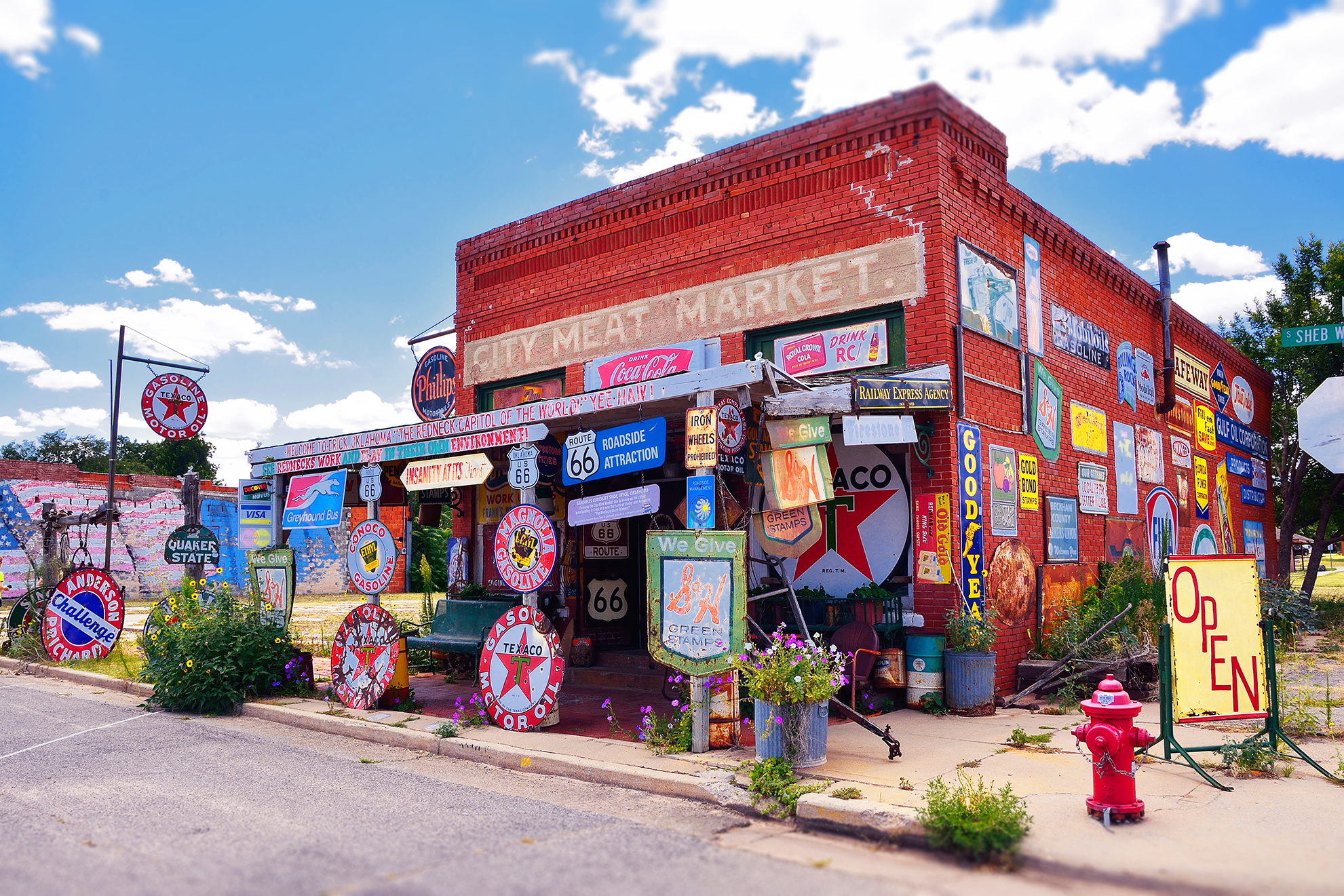
The pavement keeps changing. The meaning keeps changing. The road keeps disappearing and, somehow, keeps coming back. An ouroboros. A snake swallowing its own tail.
Route 66 was built to get somewhere, then it got replaced for being too slow. Then it got famous for no longer going anywhere at all, and for not going anywhere at all, terribly slowly.
Just like it always had.
Which may be the most American thing about it.

Member discussion