
Bacon, borders, and the art of Absurdia.
If I told you ahead of time (and I suppose I am), this next absurdity dealt with securing national borders and ever-deteriorating relations with Canada, you'd probably think something like, "Yeah, no, bro. Already have plenty of that. Thanks, tho."
Yeah. Me, too.
But what if I told you it involved a war nearly starting over a dead pig?
Gotcha.
Even in the 1850s, the Oregon Territory (today's Oregon and Washington states) wasn't known for having an unusual hostility toward pigs, but it was known for having gold. Long-haired prospectors who hadn't fared well in California made the easy-ish, hot-diggity hop, skip, and jump north, right up the coast, in a rush where, odds were, they also didn't fare very well, once again.
Fortunately, even though they hadn't struck it rich, they had the Donation Land Claim Act to help them out of their jam. It essentially gave away free land to folks who decided to settle down and sink roots. By "folks," I mean white people, of course, and maybe a "half-breed Indian" or two. But that's it. Really. (Seriously; it was written into law.) Being Oregon, though, it was one of the first laws to give women 50% of their spouse's land rights.
So very progressive.
Several dry-claim miners took up the offer, and a few of them used the Act to stake-out land on San Juan Island, where they thought they'd try their luck growing potatoes (which feels like a natural career progression, somehow).
But, it turned out, someone was already there. No, not Indigenous peoples, silly; we were well on our way toward literally eradicating that problem. No, this was worse. These were Irish. Specifically, they were Irish who'd been brought in to work on a large sheep farm owned by the Hudson Bay Company, Great Britain's Canadian cousin to its East India Company.
In the decade prior, the U.S. and U.K. had put their heads together and hammered out the Oregon Treaty, which settled, once and for all, the border between the two nations. Sort of. I mean, there's supposed to be a little ambiguity built into laws and treaties, right?
And there was. Ambiguity. A water-channel. Or, more precisely, two channels. The treaty said the border was to pass through "the middle of a channel," so choosing one channel would make San Juan British, while choosing the other would make the island American. Which was it? Strangely, the treaty never grew a mouth and told us, but you'd better believe capitalism filled the vacuum with a whooshing sound.
Hudson Bay moved in with sheep and Irish (probably in that historical order), and then so did the American potato farmers. As it turned out, though, the Irish had not only come with sheep, they'd also arrived with pigs, and pigs love potatoes.
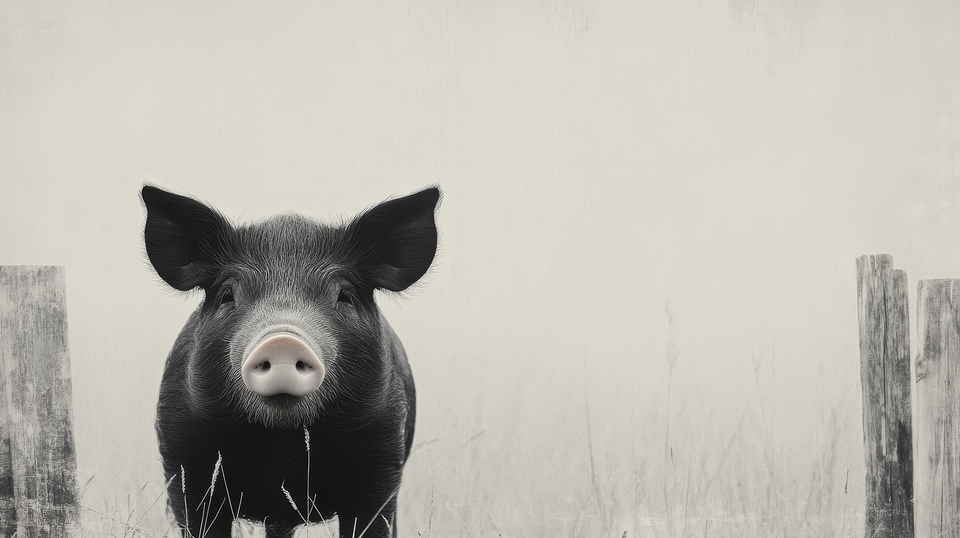
One day in 1859, Lyman Cutlar, an American potato farmer on San Juan, walked out on to his front porch to find a large, black pig standing in his potato patch, doing what pigs do... for like the four-hundredth time. I'm saying the pig had priors. Was a well-known felon.
So Lyman shoots the pig.
To his credit, he regretted it almost immediately and offered his Irish neighbor $10 for the loss. The neighbor? He demanded a Benjamin (which is ironic, since those wouldn't be printed until 1914). That's the difference, in 2025 Dollars, between a $360 offer and a $3,600 counter-demand. (It'll seem even worse when we look back using 2026 Dollars, later.) Things turned into a predictable shouting match, and the British threatened to arrest the pig-killer. Lyman, and his potato-growing buddies, appealed to the U.S. Army for American military protection.
And of course they got it.
An American General renowned for his brutality, William Harney (known as "The Bear," and not because of foreknowledge of the excellent Hulu/FX series), had been looking to pick a fight with the British for months, so he sent 66 soldiers off to San Juan Island under the command of a young captain named George Pickett. Pickett was to become known for his total love of multiculturalism, so much so he sent his troops out to be utterly annihilated in battle a few years later, marching off to their deaths on the losers' side of America's Civil War.
So the choice of command made some sense.
Britain responded (because Britain always responds) by sending three warships and over two thousand men. Two thousand men. Seventy cannons. All pointed at a potato farm. Because of a pig. (And ambiguity.)
The joint, fully-armed, military stare-down lasted twelve long years, at the end of which everyone had forgotten the pig entirely, and a German kaiser was asked to arbitrate the border dispute, eventually giving the island to the Americans.
Total human casualties: zero. Total pig casualties: one.
Total Absurdia: infinite.
So I ask, what is it with borders, Canada, and pigs? "History," as Twain wrote, "doesn't repeat itself, but it rhymes."


Member discussion